


 ×
Diagnostic OAE systems provide precise, repeatable measurements of the integrity of the cochlear outer hair cell function, in patients of all ages. Built for audiologists, ENT specialists, and pediatric audiologists who need dependable results for early identification and longitudinal assessment of cochlear dysfunction for hearing care.
Products
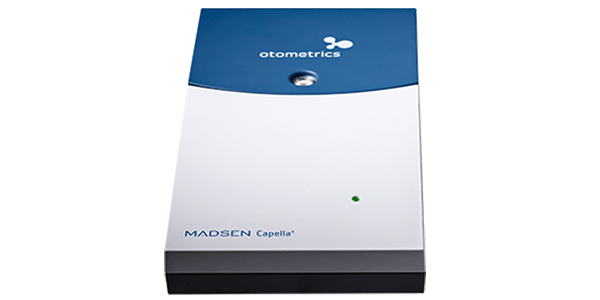
Advanced OAE system offering customizable DPOAE, TEOAE, and SOAE testing with precise stimulus calibration and flexible frequency control for accurate cochlear assessment.
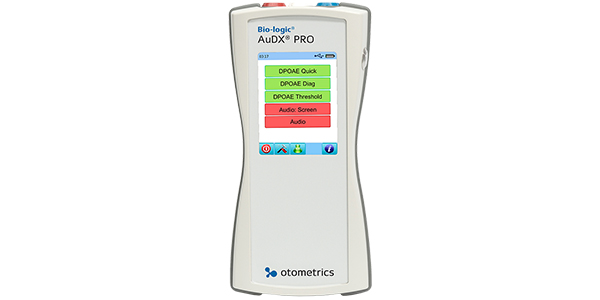
Handheld configurable OAE device with advanced diagnostic options with the possibility of adding advanced or play audiometry in a single device.
Otoacoustic emissions are the faint sounds the cochlea produces to an external stimulus. When the outer hair cells of the inner ear respond to sound, they move in an active process, the cochlear amplifier, generating soft sounds that travel back through the middle ear to the ear canal. A small probe in the external auditory canal records these emissions, giving an objective window into cochlear function that needs no behavioral response.
Present OAEs are generally consistent with functioning outer hair cells, while reduced or absent OAEs may reflect cochlear dysfunction but can also be influenced by middle-ear status, probe fit, and test conditions. That makes OAE testing useful for detecting changes in outer hair cell function and supporting early identification of cochlear dysfunction. It is especially useful in young children and anyone who cannot complete pure tone audiometry, and it cross-checks methods such as visual reinforcement audiometry. When interpreted with ABR, OAE results can support identification of auditory neuropathy spectrum disorder, in which outer hair cell function may be preserved despite abnormal neural responses.
The Madsen Capella² performs all three, while the Bio-logic AuDX PRO provides handheld modular OAE testing, including screening OAE, diagnostic OAE, input-output OAE, and threshold estimation OAE.
Across settings, from contributing to follow-up after newborn hearing screening to monitoring cochlear function over time, these systems give clinicians a reliable, objective read on outer hair cell function.
Frequently asked questions
What are otoacoustic emissions, and how are they measured?
Otoacoustic emissions are faint sounds the cochlea produces when the outer hair cells of the inner ear respond to sound. A small probe placed in the external auditory canal delivers a stimulus and records the emissions that travel back out through the middle ear. Because the measurement is objective and does not rely on a behavioral response, it is used across newborn hearing screening, pediatric assessment, and the diagnostic evaluation of hearing loss.
What is the difference between DPOAE, TEOAE, and SOAE?
They measure otoacoustic emissions in different ways. A Distortion Product OAE (DPOAE) presents two pure tones and records the distortion product the cochlea generates, mapping outer hair cell function across a frequency range. A Transient-Evoked OAE (TEOAE) uses a Click, Chirp or Tone Burst to evoke a broadband response. A Spontaneous OAE (SOAE) is an emission the ear produces without any external stimulus. The Madsen Capella² performs all three.
What do otoacoustic emissions tell you about hearing?
Otoacoustic emissions reflect the function of the outer hair cells in the cochlea. Present, robust emissions are consistent with functioning cochlear outer hair cells in the tested frequency region, but do not by themselves establish normal hearing sensitivity. Because OAEs provide objective information about cochlear outer hair cell function, they are often interpreted alongside pure-tone audiometry, tympanometry, and ABR.
Why is OAE testing useful for young children and newborns?
Newborns and young children cannot give a reliable behavioral response to sound, so an objective measure of cochlear function is valuable. OAE testing is quick, noninvasive, and requires only a small probe in the ear canal, which makes it well suited to supporting follow-up after a newborn hearing screening result and to pediatric assessment where behavioral methods such as visual reinforcement audiometry may be limited.
What is the difference between the Madsen Capella² and the Bio-logic AuDX PRO?
Both perform diagnostic OAE testing, but they suit different settings. The Madsen Capella² is an advanced system with customizable DPOAE, TEOAE, and SOAE testing, precise stimulus calibration, and flexible frequency control for detailed cochlear assessment. The Bio-logic AuDX PRO is a handheld modular device that can be configured to combine diagnostic OAE with screening or diagnostic audiometry. The choice depends on whether a clinic needs a full diagnostic platform or a flexible handheld unit.
Does Natus Sensory offer service and support for OAE systems?
Yes. Accurate OAE results depend on a well-calibrated instrument, so each system should be maintained and calibrated according to the manufacturer’s recommendations. Natus Sensory provides global service, calibration, technical support, and clinical education to support reliable performance and ongoing clinical use.

Request a quote
Ready to make a difference in patient care?
Learn more about our industry-leading solutions and how we can help advance your care capabilities.
054670 RevA