

 ×
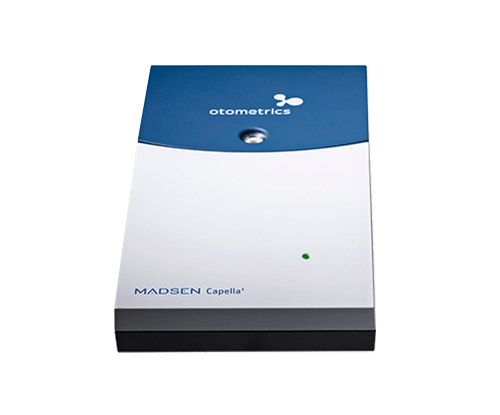
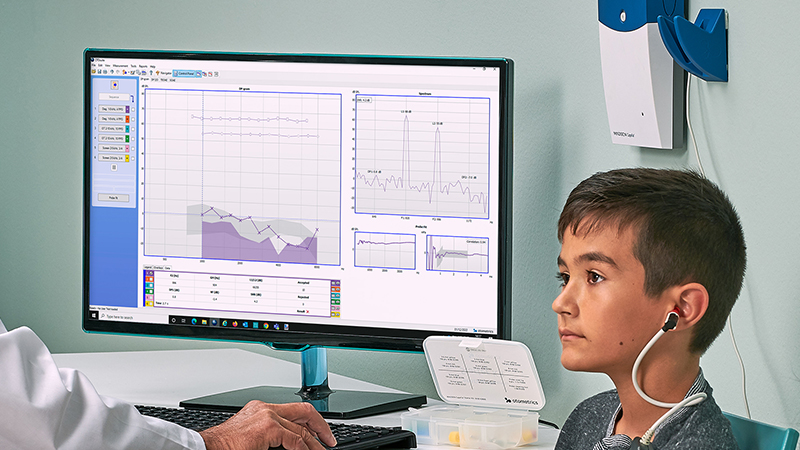
Madsen Capella² provides objective OAE measurements to assess cochlear outer hair cell function across patients of different ages. Built for audiologists, ENT specialists, and pediatric audiologists, it performs distortion product (DPOAE), transient-evoked (TEOAE), and spontaneous (SOAE) otoacoustic emission analyses in a single connected workflow. Because OAE testing does not require a behavioral response, it provides an objective measure of cochlear outer hair cell function in newborns, young children, and other patients who may not complete behavioral audiometry reliably.
Otoacoustic emissions are low-level sounds generated by active processes involving cochlear outer hair cells. Some OAEs are evoked by acoustic stimulation, while spontaneous OAEs occur without an external stimulus. Measuring them provides an objective window into cochlear function, which is why OAE testing is widely used in pediatric and diagnostic audiology, as a cross-check within the audiologic test battery and for applications such as longitudinal monitoring of cochlear function. Madsen Capella² pairs this clinical value with the flexibility to configure test frequencies precisely, choose the right calibration method for each case, and compare results against normative values, all through the Otosuite software platform.
Not available in all countries. Please contact your local Natus Sensory representative for availability.
An otoacoustic emissions solution that works the way you do
Madsen Capella² adapts to both routine OAE testing and more advanced diagnostic applications. Its two calibration methods let clinicians match the approach to the case: Chirp calibration supports efficient general testing, while Optimized In Situ calibration provides greater confidence in data collection when small response differences are clinically important. Combined with historical probe fit and data comparison, this makes it possible to assess cases where slight changes in the response matter, such as monitoring patients on ototoxic treatment over time.
PrecisePoints™ lets the operator define exactly the test frequencies they want, from commonly used audiometric frequencies to any combination configured manually. Everything runs through Otosuite, the proprietary Natus Sensory software platform, with test and measurement settings selected from an intuitive control panel. When you choose Madsen Capella², you choose Natus Sensory as a long-term partner, with clinical education and technical support designed to support ongoing system performance and clinical use.
Product Information
Specifications
DPOAE Specification
Stimulus: Frequency range: 500-10000 Hz
Frequency step: 1 Hz
Level: 0-75 dB SPL (Dependent on frequency)
Level step: 1 dB
Recording: Acquisition time: 204.27ms
A/D resolution: 16 bit
Preprogrammed and User Defined Protcols
Multiple Normative Data Sets
Choice of Chirp or Optimized In Situ calibration
TEOAE and SOAE specifications
Stimulus: Click and Tone Burst
Levels 40-90 dB SPL
Frequency Bandwidth: 450-5000 Hz
TEOAE: Correlation and SNR (per band, and\or overall)
SOAE: Asynchronous and Synchronous (levels btw 40 and 60 dB SPL)measurements
Preprogrammed and User Defined Protocol
Frequently asked questions
What is otoacoustic emissions testing, and how does it work?
Otoacoustic emissions testing measures low-level sounds produced by the outer hair cells of the inner ear in response to external stimuli delivered through a probe in the ear canal. Present OAEs are generally consistent with functioning outer hair cells, while reduced or absent OAEs may indicate cochlear dysfunction but can also be influenced by external or middle-ear conditions, probe fit, and test environment. OAE testing is used across pediatric and diagnostic audiology and may also form part of newborn hearing screening programs when dedicated screening protocols and equipment are used.
What is the difference between DPOAE, TEOAE, and SOAE?
They measure otoacoustic emissions in different ways. A DPOAE measurement presents two pure tones and records the distortion product the cochlea generates in response, mapping outer hair cell function across a frequency range. A transient-evoked OAE (TEOAE) uses a click or tone burst stimulus to evoke a broadband response. A spontaneous OAE (SOAE) is an emission the ear produces without any external stimulus. Madsen Capella² performs all three, with DPOAE across 500 to 10000 Hz and TEOAE and SOAE across a 450 to 5000 Hz bandwidth.
Why is OAE testing used for newborn hearing screening?
An objective measure of cochlear outer hair cell function is valuable in infants and young children who cannot provide reliable behavioral responses An OAE test is quick, noninvasive, and requires only a probe in the outer ear canal, which makes OAE testing valuable in pediatric assessment and in newborn screening when used within an appropriate screening protocol. Early identification of hearing loss supports timely intervention, which is associated with better long-term outcomes in speech and language development. When auditory neuropathy spectrum disorder is suspected, OAE findings are interpreted alongside ABR and other audiologic measures to assess outer hair cell function and neural auditory responses.
What is the difference between Chirp and Optimized In Situ calibration?
Chirp calibration is designed for speed and, combined with predefined measurement settings, is well suited to general testing of patients. Optimized In Situ calibration provides greater confidence in data collection, while historical probe fit and data comparison support assessment of cases where small response changes are clinically important.
Does Natus Sensory provide training and support for Madsen Capella²?
Yes. Madsen Capella² should be maintained and calibrated according to the manufacturer’s recommendations to support reliable measurement performance. Natus Sensory provides service, technical support, calibration services, and clinical education to support reliable system performance and consistent testing workflows.
Resources and Support
Related Products
Contact
7-36-9061-EN_02