


 ×
×
Diagnostic and screening tympanometers designed for accurate middle ear assessment, acoustic reflex testing, and eustachian tube function evaluation in audiology and ENT settings.
Products
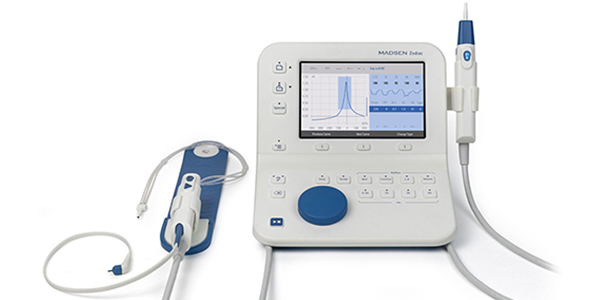
Immittance testing system with Gen 2 probe technology, Dual Probe™ functionality, and Otosuite® integration for screening, diagnostic, and clinical tympanometry.
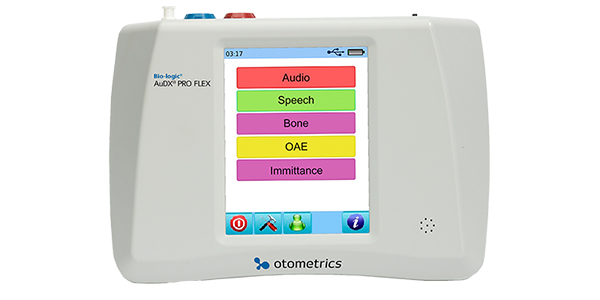
Portable handheld tympanometer combining screening and diagnostic tympanometry with modular OAE and audiometry options in a single device.
Tympanometry is an objective test of middle ear function that measures how the tympanic membrane responds to controlled changes in air pressure within the ear canal. A probe tip creates a sealed space in the ear canal while a probe tone is emitted, producing a tympanogram that shows ear canal volume, middle ear pressure, and the compliance peak.
Clinicians use tympanometry to help identify middle ear conditions such as otitis media, middle-ear effusion, fluid buildup, and eustachian tube dysfunction that can contribute to hearing loss. Paired with acoustic reflex testing, including ipsilateral reflexes, contralateral reflex testing, and reflex decay, it supports differential diagnosis across the middle ear, inner ear, and auditory pathway.
These capabilities support hearing care professionals in delivering reliable acoustic reflex measurements and tympanometry results across a comprehensive range of clinical applications, from pediatric middle ear infection follow-up to adult diagnostic evaluations for hearing loss
Frequently Asked Questions
What does a tympanometer measure?
A tympanometer measures the mobility of the tympanic membrane and middle ear system by varying air pressure in the ear canal while emitting a probe tone. The resulting tympanogram shows ear canal volume, middle ear pressure, and compliance peak height, helping identify otitis media, middle-ear effusion, fluid buildup, or eustachian tube dysfunction.
When is tympanometry used in clinical practice?
Tympanometry is used to help identify the cause of conductive hearing loss, monitor patients with recurrent ear infection or middle ear infection, screen for middle ear pathology in children, and assess eustachian tube function. It complements audiometry and otoscopy in a full hearing evaluation.
What is the difference between screening and diagnostic tympanometry?
A screening tympanometer quickly flags abnormal middle ear function, while a diagnostic tympanometer adds multiple probe tones, reflex decay, ipsilateral reflex tests, contralateral reflex testing, and eustachian tube function protocols. The Madsen Zodiac is available in Quick Check, Diagnostic, and Clinical configurations; the Bio-logic AuDX PRO FLEX offers both in a portable format.
What probe tones do Natus Sensory tympanometers support?
The Madsen Zodiac supports 226 Hz, 678 Hz, 800 Hz, and 1000 Hz probe tones. The 226 Hz tone is standard for children and adults, while the 1000 Hz tone is recommended for infants under six months, whose ear canal and middle ear system respond differently due to ongoing development.
What is acoustic reflex testing, and how does it relate to tympanometry?
Acoustic reflex testing measures the involuntary contraction of the stapedius muscle in response to a pure tone stimulus. Acoustic reflex measurements, including ipsilateral reflexes, contralateral reflex testing, and reflex decay, help evaluate the middle ear, inner ear, and auditory pathway. Diagnostic tympanometers such as the Madsen Zodiac include acoustic reflex testing as part of a complete immittance battery.
How does tympanometry help identify eustachian tube dysfunction?
Eustachian tube function testing uses tympanometry to measure middle ear pressure changes before and after swallowing or Valsalva maneuvers. Patients with eustachian tube dysfunction often show persistent negative pressure, flattened tympanograms, or difficulty equalizing pressure. The Madsen Zodiac includes ETF-I and ETF-P protocols for this assessment.
Does Natus Sensory offer service and support for tympanometers?
Yes. Every tympanometer is a precision medical device that requires regular calibration to produce accurate acoustic reflex measurements and tympanometry test results. Natus Sensory offers global service programs, calibration, technical support, and clinical education resources for hearing care professionals.

Request a quote
Ready to make a difference in patient care?
Learn more about our industry-leading solutions and how we can help advance your care capabilities.
053414 RevA