
 ×
×
Understanding your dizziness
Dizziness is more common than many people realize. In fact, it’s the second most common reason people visit their doctors (lower back pain is first). It’s estimated that as many as 40% of all adults experience dizziness severe enough to warrant reporting it to their doctors. Fortunately, many causes of dizziness can be identified and treated, especially with the introduction of sophisticated new diagnostics methods, medications, and advanced surgical techniques.
A distinct experience
Dizziness doesn’t feel the same to all people. So it’s helpful if your physician knows exactly what you are experiencing when you report dizziness. For some people, it’s lightheadedness. Others feel faint. Some simply have difficulty maintaining their balance and may feel like they are about to fall. To some, it feels as if they are moving when they are not. For many, it is the sensation of the world spinning around them or they are spinning themselves. All of these sensations are a common form of dizziness called vertigo.
Other common symptoms
Dizziness often occurs along with other symptoms like nausea, pressure or fullness in the head or ear, ringing in the ear called tinnitus, or hearing loss. Once again, it’s important that your doctor knows if these or any other problems accompany your dizziness.
Dizziness is a frustrating symptom similar to pain. Like pain, dizziness can affect one’s quality of life but it is also a signal that something is wrong – something we need to detect and treat.
A symptom with many possible causes
Dizziness can be a symptom of many different diseases. When you report dizziness to your physician, the first challenge is to diagnose the underlying cause. Most common are vestibular disorders – problems that affect the inner ear, particularly in the vestibular system which controls our sense of balance. Many of vestibular disorders are caused by bacterial or viral infections that affect the inner ear.
Diseases and injuries that affect the brain or the central nervous system can also cause dizziness but they are not as common as vestibular disorders. Other less-common causes of dizziness include heart and metabolic problems such as high blood pressure or anemia. Dizziness may even be a side effect of medications. Be sure to let your physician know the medications you are taking, especially if there has a been recent change in your prescriptions.
The diagnostic process
The more specific you can be about how long ago your dizziness began, when episodes are most likely to occur, and what sensations you are experiencing, the more likely it is that your physician can develop a more accurate diagnosis. Sometimes, a specific cause for dizziness can’t be identified. But by eliminating the more serious possibilities, you and your physician can confidently manage your symptoms and enable your body’s self correcting capabilities to take effect. The diagnostic process is both an art and a science – a partnership between you, your physician, and other healthcare providers who are participating in your medical care.
Diagnosing dizziness can be complex and the process usually requires multiple tests. In most cases, you’ll start with a detailed medical history and a physical examination. Because the balance
system is located primarily in the inner ear, a hearing test is a common diagnostic procedure.
The role of eye movement testing in the diagnosis of dizziness
Although your balance sensors are located primarily in the inner ear, they communicate with other sensory centers such as eyes, muscles, and joints, through their connections within the brain. Each of these centers sends and receives messages that permit you to maintain your balance and have clear vision while moving. When one or more of these centers or their connections in the brain malfunctions due to disease or injury, these messages become distorted and cause you to feel dizzy.
One clearly measurable sign of what’s going on with your balance system is rapid, involuntary eye movements called nystagmus. By stimulating the balance sensors in various ways and then carefully measuring your eye movements, your physician can learn much about any abnormalities in your vestibular system. One of the most common balance tests is videonystagmography or VNG. In VNG, eye movements are measured by video cameras that track the eyes. ENG or electronystagmography is an older version of VNG where eye movements are recorded by electrodes placed on the face.
Recently, two new balance tests have become available providing additional information about the causes of dizziness. One of these tests, video head impulse test or vHIT also uses eye movement measurements. The other test, vestibular-evoked myogenic potentials or VEMP, uses sounds to stimulate the neck or eye muscles. The muscle responses are measured by small electrodes placed on the neck or under the eyes.
VNG consists of a series of tests that can contribute significantly to the information your doctor needs to diagnose your dizziness. One test is the saccade test, which examines rapid eye movements as you look at different targets. Another is the tracking (e.g. smooth pursuit) test that measures your ability to follow a slow moving target. In gaze test, eye movements are measured as you stare at stationary targets. Skew deviation measures eye movement when one eye is covered and uncovered. Another part of the test involves placing you in different positions or moving you from one position to another to determine the effect on your symptoms.
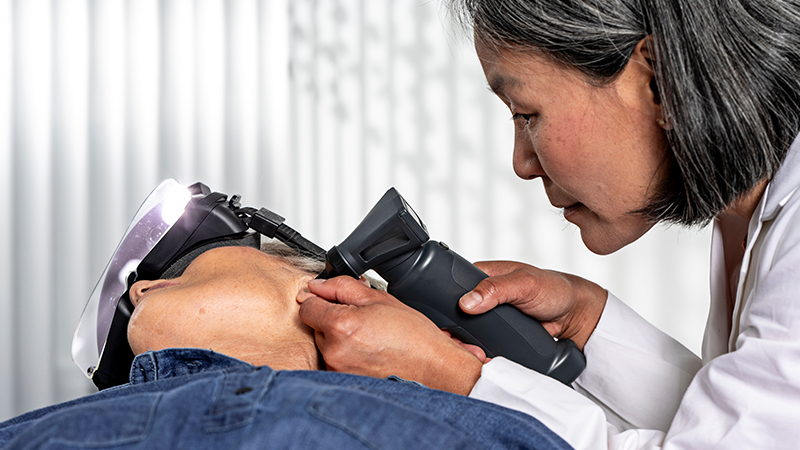
An important part of VNG is the caloric test. It involves introducing warm and cool, air or water into the ear and then measuring the resulting changes in eye movements. During VNG, goggles that house sophisticated cameras are placed over your eyes. An alternative is ENG in which electrodes are placed near the eyes. Both methods are designed to carefully monitor your eye movements. vHIT measures your eye movements as you stare at a fixed target and as the clinician moves your head left, right, up, and down. In VEMP testing, electrodes are placed on your neck and/or below your eyes. Sounds are presented and muscle responses are measured as you contract your muscle by turning your head or by looking upward. For some of the tests you will be seated, observing light targets. The target movements are precisely controlled to produce different types of eye movements. For other procedures, such as the caloric test, you will be lying down. The entire sequence usually takes about 20 to 90 minutes depending how many tests are performed. Your physician may order some or all of these tests, and may refer you for other tests depending on your history and symptoms. Each test contributes distinct and valuable information to your overall diagnostic picture, which may not be available through any other means.

Getting back on balance
Based on your vestibular test results, your doctor may arrive at a diagnosis.
In some cases, accurate diagnosis will require further test procedures. Once a diagnosis is determined, a range of treatments is available to control most of the conditions underlying dizziness. Some conditions can be managed with medication and/or diet. Some can be treated with special “maneuvers” which involve simple movements of the head and body. Others require physical therapy and exercise. In rare cases, surgical intervention may be needed. Whatever the cause of your dizziness, the key to the solution is a timely, accurate diagnosis made possible by advanced diagnostic instrumentation followed by careful adherence to your physician’s treatment plan.
7-26-1137-EN Rev01